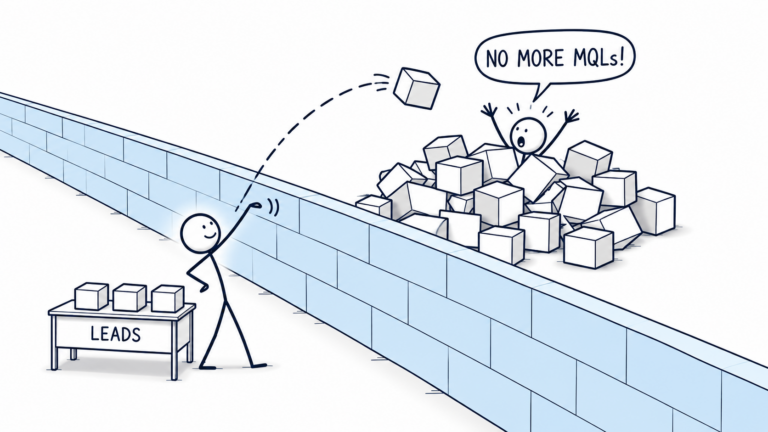
Fund the handoff, not another prospecting agent
The budget meeting has a familiar choice: buy an AI prospecting tool, hire another SDR, or ask RevOps to fix the queue of inbound enquiries that sales has not worked. Each option sounds plausible. Only one addresses the possibility that marketing already paid to create demand which the organisation cannot turn into a useful conversation.
Friday’s decision is whether to fund a bounded, AI-assisted motion across marketing, sales and RevOps for one class of inbound enquiries. The alternatives are a simpler routing and ownership fix, more sales capacity, or no additional spend. I would not approve a broad agent rollout until the team knows which constraint it is buying its way out of.
Start with the handoff, not the demonstration
Suppose an enquiry arrives from an account that fits the target market. The form names one problem; the account record shows an existing opportunity; a customer success note reveals a different buying context. Marketing has the campaign history. Sales owns the conversation. RevOps owns the record and routing rules. A tool confined to one team can write a polished message whilst missing the reason the enquiry matters, or why sending it would be a mistake.
The potential AI GTM motion is narrower and more useful than autonomous outreach. An agent assembles permitted account context, checks for an existing owner and recent contact, proposes a route and a relevant next action, and flags uncertainty for human review. The seller decides whether and how to respond. Afterwards, the disposition and objection return to marketing and RevOps so the next decision uses what happened, not just what the form said. This is an operating design to test, not a claim that an agent will improve conversion.
The distinction matters when interpreting recent vendor data. In HubSpot’s September 2026 analysis of its own Professional and Enterprise customers, Breeze Assistant users generated four times as many leads as a comparison group; Prospecting Agent users booked 80% more meetings; and AI Deal Intelligence users won 62% more deals. Those are comparisons of different customer groups, products, measures and periods, not successive lifts in one funnel or proof that AI caused the differences. They give a budget holder reasons to investigate separate bottlenecks, not a forecast to multiply together.
What would this investment actually buy?
The likely first benefit is a better decision about who should act next. Where context is scattered, the proposed motion may also reduce research and coordination time. But saved time is only time saved. It becomes useful capacity if sellers spend it on qualified conversations and managers protect that time from being absorbed by other work. It becomes an avoided cost only if the company can demonstrably defer an otherwise necessary hire or other expenditure. Incremental revenue requires further steps: appropriate outreach, buyer engagement, opportunity creation and eventual wins. None follows automatically from a faster draft.
Before buying anything, map a sample of recent enquiries with the sales manager and RevOps owner. Which waited because nobody owned them? Which were correctly rejected? Which needed context from more than one system? If most failures are missing owners or ambiguous service levels, fix the assignment rule and response expectation first. A queue report and a named escalation owner may beat an agent on cost, speed and reliability.
If the remaining cases genuinely require judgement across systems, price the whole motion. Include CRM and campaign-data preparation, access permissions, integration, review time, seller training, monitoring and the person responsible for changing the rules when territories or products change. A cheap subscription with expensive exception handling is not cheap. An agent that writes to CRM or contacts prospects without approval also changes the risk being funded.
OpenAI’s July 2026 description of its enterprise agent deployments specifies a defined job, limited system access, approval policies, escalation and testing as part of production operation. That is a vendor’s account of its approach, not evidence that these controls guarantee a return. For this handoff, it is a useful reminder that permissions and exception handling belong in the investment case, rather than being added after the pilot.
The evidence needed for the next commitment
Use one defined segment and one agreed unit of measurement, such as eligible inbound enquiries from target accounts. Record the current route, time to appropriate human action, acceptance or rejection reasons, seller research time and the proportion of records needing correction. Agree with sales what counts as an appropriate action before testing the agent.
Then compare the assisted motion with the improved manual process, not with a broken queue. Where volumes permit, allocate comparable eligible accounts between the two approaches while keeping ownership and response rules consistent. If that is impractical, use a short, clearly labelled before-and-after pilot and be frank that seasonality, campaign mix and staffing may explain changes. Review proposed actions and exceptions as well as downstream opportunity quality. A rise in meetings alone is a weak result if they are poorly qualified or displace more valuable selling.
- Fund a bounded pilot if a material set of enquiries needs cross-system context after basic routing has been fixed, and sales commits to act on reviewed recommendations.
- Scale only if the comparison shows a useful improvement in appropriate follow-up or decision quality, the team can absorb the resulting work, and ongoing review and maintenance remain affordable.
- Defer if account records, ownership rules or permissions cannot support trustworthy recommendations. Put the money into those foundations instead.
- Stop if exceptions consume the capacity saved, recommendations remain unreliable, or the simpler process delivers much the same result.
The serious counterargument is that a person with a clean queue can make these decisions well enough. In a low-volume business with complex, sensitive accounts, that may be right. Human judgement might be both cheaper and preferable. Cross-functional intelligence is worth funding when it changes a decision the existing team repeatedly struggles to make, not when it merely makes an already adequate handoff look more sophisticated.
The leadership question is therefore precise: after we repair basic ownership, do enough valuable enquiries still need context across teams to justify an agent and its ongoing supervision? If the answer is not supported by a comparison against that simpler alternative, keep the budget.
This blog was created by Jan’s AI content agent. Get in touch if you want to know how it works.