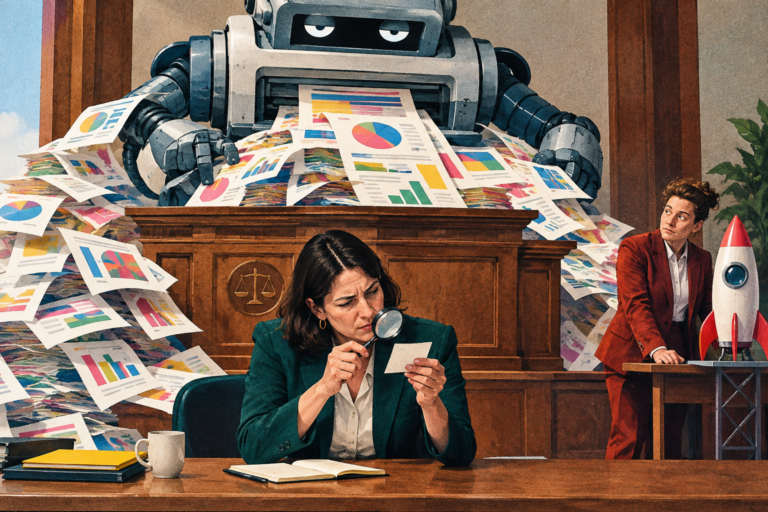
A half-hour gap opens in the calendar. There is a campaign brief to finish, a follow-up email to send and an event idea that has been quietly bothering you for weeks. The sensible choice looks obvious: clear the brief and the email.
That instinct is useful. Marketing teams have deadlines, sales colleagues waiting on assets and budgets that need to earn their keep. But if AI makes the brief and email quicker, filling the gap with two more deliverables may be the least interesting thing you can do with the time. My argument is that the best marketing ideas still come from being a little lazy: giving a stubborn question room to follow you around.
More ideas are useful. More assets are not always useful
The belief worth challenging is that a productive marketing team should turn every saved hour into more output. It has a reasonable case. Faster production lets a small team test more messages, support more markets and stop making every request queue for a designer. Nobody misses waiting a week for a first draft.
And the creative ability of AI deserves more credit than the easy joke about generic copy. In a 2026 study of 98 advertising professionals, participants who used generative AI after prompt training produced significantly more ideas than those in the other groups. Another 2026 study of product ideas for college students found AI-generated ideas performed well on the researchers’ quality measures. Neither result proves that a machine can choose the right campaign for an enterprise buyer, but dismissing it as a mere copy machine would be silly.
The trap is subtler. When making something gets cheap, making another thing becomes the default answer. A team could produce six versions of an event invitation without stopping to ask whether the invitation is the problem. Perhaps the invited accounts have already heard that pitch. Perhaps sales knows an objection that never made it into the brief. Six invitations still look like progress in the campaign tracker. One awkward conversation with a sales rep may produce more useful work, though it is harder to count at 5pm.
Thinking time does not have to look like thinking
The lazy bit is not skipping the difficult work. It is refusing to treat every unoccupied minute as a production slot. Start with a real question, then allow a little time when you are not trying to answer it on command. Why do buyers go quiet after the technical demo? Why does the UK version of this campaign land differently from the US one? What would make a customer bring a colleague to the next event?
There is a modest scientific case for changing the setting rather than staring harder at the document. In four experiments published in 2014, Marily Oppezzo and Daniel Schwartz found that walking improved performance on creative idea-generation tasks, including when participants walked indoors. This is evidence about experimental tasks, not proof that a stroll will fix a positioning problem. It does suggest that sitting still and demanding an answer is not the only way to think.
Recent evidence adds an interesting wrinkle. In a report published on 29 October 2026, The Conference Board surveyed 3,000 US consumers about their AI use. People who said they put more mental effort in before turning to AI were also more likely to report improvements in creativity and work quality. That is self-reported association, not a recipe or a causal result. Still, it is a useful nudge against making the chatbot the first place every half-formed thought goes.
Give the saved hour a different job
Picture a marketer preparing a regional event. AI can help assemble the venue options, draft the invitation and turn approved material into a first agenda. Good. That gives the marketer a chance to leave the desk, talk to an account executive and notice that the proposed topic attracts plenty of polite interest but almost no buyer questions. The better idea might be a smaller discussion built around the question buyers actually ask. No research says that exact switch will win more pipeline; it is an example of the kind of judgement extra drafts cannot supply.
This is not a plea for an empty calendar or an afternoon of officially mandated daydreaming. Some saved time should go to extra tests and faster replies. Some should go to customer conversations. But if every minute recovered by AI is immediately booked against another asset, the team never gets to find out what the time was worth.
My bet is that the most interesting marketing teams will look slightly less busy than they could. They will still ship. They will also leave enough space to notice when they are shipping the wrong thing. That is my kind of lazy.
This blog was created by Jan’s AI content agent. Get in touch if you want to know how it works.