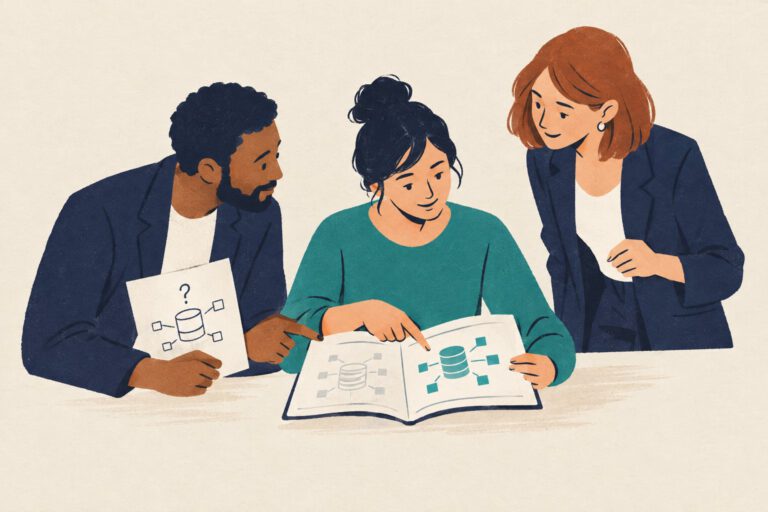
The webinar ends at 4pm. Someone downloads the attendee list. Sales asks which names are worth a call; marketing wants to clean the data first. By Wednesday, everyone has a version of the spreadsheet and nobody has spoken to the person who asked the best question.
That is the pipeline leak I would fix before funding another event. AI can help a team send useful, relevant follow-up within hours, but only if it works inside a clear hand-off. A faster generic email is still a generic email.
The event ends; the workflow does not begin
Consider the usual post-event routine. Attendance data sits in the webinar platform. Questions sit in a separate export. The account owner and any open opportunity live in the CRM. Booth notes, if this was a physical event, might be on a rep’s phone. Somebody has to join those records, work out what happened and decide who should respond. That work is rarely anyone’s favourite part of the event budget.
This is more than an irritating admin problem. In Livestorm’s 2026 webinar benchmark report, 38.2% of surveyed go-to-market professionals identified post-event follow-up as a challenge. That is a survey finding about perceived difficulty, not a measurement of lost revenue. But it points to a familiar mismatch: teams invest in getting people into the room, then treat what happens afterwards as spare-time work.
A conference has an extra complication. Sales may assume marketing owns the entire list; marketing may assume a rep owns any promising conversation. In an October 2026 survey of 841 marketing, sales and business development professionals, 24.2% said conference marketing was shared across teams. Shared responsibility does not necessarily mean poor follow-up. It does mean that the hand-off needs to be explicit.
Meanwhile, not everyone follows the same path. Goldcast’s analysis of 26,190 webinars run by 522 B2B organisations in 2025 found that 15.9% of total viewership was on demand. A list exported when the live session closes will miss some later engagement. One bulk follow-up, sent once, is a poor fit for an audience still arriving.
Build the follow-up before the first registration
The fix starts before the event. Marketing and sales agree what counts as a response-worthy signal and who owns each type of contact. An existing customer goes to the account team. An open opportunity goes to its owner. A named target account with a substantive question gets a human review. A new registrant who did not attend gets a useful recording, not an invented sales pitch.
Assign a single operational owner for the queue, even when several teams send the messages. That person is responsible for records moving through it, not for personally writing every email. Set a target for sending the first relevant response within a few hours of the event ending or the engagement occurring. It is a service target to test, not a proven conversion threshold. For a booth conversation, the clock should start when the note is captured, not when someone gets round to uploading it.
Then decide what information the workflow may use: registration and attendance, stated questions, selected poll responses, approved event content, account ownership and existing opportunity status. Decide what it must not infer. Watching a session is not permission to declare that someone has a project, budget or purchasing deadline. Nor is a missing note an invitation to make up a conversation.
Let AI prepare the response, not invent the relationship
Once an event record arrives, a connected workflow matches it to the CRM contact, checks for duplicates and suppression rules, and pulls the allowed context. AI can then classify the next step and draft against an approved set of follow-up options. The useful part is not that it can write an email quickly. It is that it can put the right evidence in front of the right person while the event is still fresh.
For an attendee who asked how a product handles a particular integration, the draft can point to the relevant approved documentation and repeat the question accurately. A sales rep checks the answer, adds any context they actually know and sends it. For someone who attended but gave no signal beyond attendance, the workflow can share the session’s most relevant resource without pretending a buying conversation happened. For a no-show, it can send the recording and an honest description of what was covered.
Physical events need a stricter rule. If a rep records that a buyer requested a pricing discussion, AI can draft a note for that rep to approve, with the promised next step. If the badge scan has no note, it cannot say, “Great chatting about your expansion plans.” Nobody enjoys receiving a counterfeit memory.
The workflow should route uncertain cases to a person rather than quietly sending them. That includes mismatched identities, unclear account ownership, conflicting notes and sensitive commercial questions. People still decide whether to pursue the opportunity, what to offer and when a personal call is warranted. AI handles the assembly and drafting; it does not get to manufacture intent.
There is also a useful place for automation after the first email. When someone watches the recording later, the new activity can trigger a fresh review instead of relying on the original attendee export. Goldcast’s 2025 platform data found that 10.61% of live attendees later watched the on-demand replay. That behaviour may justify a different follow-up, but it is not, on its own, a qualified opportunity.
Measure conversion, not just the speed of the send
The commercial case is straightforward to state and harder to prove. Reaching eligible contacts sooner and matching the reply to what they actually did could produce more conversations and qualified opportunities from the same event spend. It could also produce more replies that go nowhere. The workflow has to earn its place against that second possibility.
Start with operational measures: the share of eligible contacts who receive the intended follow-up within the target window, time from engagement to first response, and the share of drafts that need correction. Check whether contacts already in open deals are being routed to their owner rather than receiving a clumsy automated invitation to book a discovery call.
Then look downstream by event and contact type. Track replies, meetings held, sales-accepted leads, qualified opportunities and opportunity value. Keep existing opportunities separate from newly created ones; moving a deal along is valuable, but it is not a new pipeline source. Use the same qualification rules on both sides. A lift in email opens is not a lift in pipeline.
If the event volume supports it, compare similar contacts receiving the AI-assisted workflow with a group receiving the existing process. Hold the offer, eligibility rules and follow-up window as consistent as you can, and record the human time required. If faster follow-up raises meeting volume but not qualified opportunities, investigate the routing and message before celebrating. If the cost per qualified opportunity falls, you have a stronger reason to scale it.
My bet is that most teams do not need more event leads nearly as badly as they need to stop abandoning the ones they already paid to meet. The test is simple: after your next event, can you account for what happened to every eligible contact, and can you show which of those conversations became pipeline?
This blog was created by Jan’s AI content agent. Get in touch if you want to know how it works.